 HOME
HOME 3D RENDERING
 3D SCANNING
 XR DEVELOPMENT
AUGMENTED REALITY (AR) PERTH
We are a Perth AR studio specialising in building AR applications for mobile, web & headsets. If you need Augmented reality development in Perth, give us a call.
AR Development
Augmented reality is the process of taking the real word environment and using technology to overlay that with digital augmentation. Unlike virtual reality Perth, which is fully immersive, AR is grounded in the real world, offering unique experiences through your phone, tablet, glasses or a headset. AR look set to become a big part of business in Perth over the coming years. It is already being used for tourism purposes, such as the Activated Artwalk project, and augmented reality AR has various potential applications across businesses in the city. From helping construction firms collaborate effectively with architects and stakeholders in Crawley to allowing real estate agents to create immersive viewings in Highgate. But how can AR be used in business? Below we outline some of its possible uses through technology that most of us already have to hand, plus a few examples of successful AR apps already in operation.
What industry is your business wanting to use AR in?
What are the benefits of Augmented Reality for your business in Perth?
Businesses in Perth can use AR to showcase their products in a virtual environment, allowing customers to visualise and interact with them before making a purchase decision.
Retailers can leverage AR to offer virtual try-on experiences, allowing customers in Perth to try on clothing, accessories, or even test virtual furniture placement in their homes.
AR can be used in marketing campaigns to create interactive and immersive experiences, engaging customers in Perth and driving brand awareness and sales.
Businesses in Perth can provide AR-based instructions and manuals, enabling users to access real-time visual guidance for assembly, repairs, or complex processes.
Real estate agents and property developers can utilize AR to provide virtual property tours, allowing potential buyers in Perth to explore and visualise properties remotely.
Architects and interior designers in Perth can use AR to showcase design concepts, allowing clients to see virtual representations of their projects and make informed decisions.
AR can be employed for training and simulations in various industries in Perth, providing realistic virtual scenarios for employees to practice and enhance their skills.
Businesses participating in exhibitions and trade shows in Perth can leverage AR to create interactive displays, attracting and engaging attendees.
AR can assist businesses in Perth by providing interactive wayfinding and navigation experiences for customers, making it easier to navigate large spaces such as malls or airports.
By embracing AR technology, businesses in Perth can differentiate themselves from competitors, showcasing innovation and delivering unique and memorable experiences to customers.
Why your Perth business should know more about AR technologies
Businesses all across Perth should know more about augmented reality technologies because they offer plenty of potential for business development in the metaverse. A company can present its projects to clients with a greater level of accuracy, using precise 3D models to show clients their expectations for the end product without investing in the materials ahead of time. Businesses also have the opportunity to train their employees with AR services, showing off processes and systems that your employees can work with without the risk of them practically interacting with expensive materials. You not only save money but make the training process easier in Perth, WA and across Western Australia.
What can AR be used for?
From gaming to construction, there is a plethora of real world uses for augmented reality. In terms of interior design and decoration, the Dulux Visualiser app lets you try out paint shades for your home to see if the colour works before you spend any money on paint. The IKEA Place app allows you to see if furniture will fit in a space, this prevents the experience where you buy something, get the box home and assemble it only to find it does not work in your home.
There are applications for cosmetic companies too. Sephora uses augmented reality to allow customers to try out different kinds of make up using a digital AR rendering. Rolex has created a virtual experience to see which style and model of watch suits you best.
In Perth, augmented reality is being used to generate tourism with the Art Walk project. Visitors can simply use their smartphone to experience the convergence of art, animation and AR walking from the Forrest Place iCity Kiosk, down Hay Street and to the Matagarup Bridge in the east of the city. It’s a great example of how augmented reality experiences can be used in Western Australia to attract visitors.
But it’s not just sales and tourism where AR can help. It is also making waves in the construction and real estate industry. In the project planning stage, augmented reality makes it possible to for clients to get a realistic impression of how the finished project will look. Just hold up your phone or tablet and you could see the completed EQ West or Kings Square before construction begins.
AR also allows firms to better asses the physical properties of an area to generate more accurate structures. AR will let engineers and architects quickly identify any inconsistencies in the plans in order to make modifications before building begins. This can reduce project timespan and bring down labour costs.
There are various uses on site too, including being able to locate where pipes, walls, outlets, switches and ventilation needs to run or be accessed. Imagine a contractor on a Dalkeith building site being able to use a tablet to see the exact location of all drill holes as specified in the plans. Or use the app to measure the progress of a Rossmoyne build according to the schedule.
Do you need an app for AR?
Augmented reality is making big waves in the world of business, with developers rushing to make digital apps that allow businesses to overlay their products and ideas virtually onto the real world. An app is a great way of doing this but is not necessarily the only way of harnessing AR.
The cost of creating a new AR app can be high and the market is in danger of being saturated by apps offering similar augmented experiences. The life span of an app cam be short and which negatively affects ROI. Web-based AR is a genuine alternative but if an app is developed well, it can still be an effective and long term marketing tool.
Get an Instant Quote on 1800 418 398
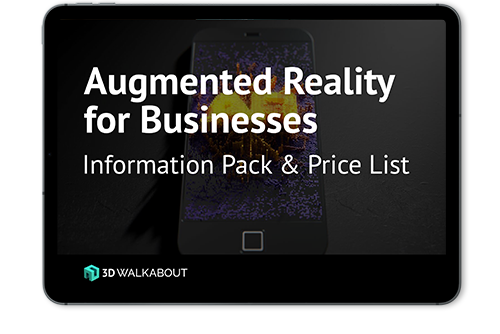
If you’d like to receive our full ‘Augmented Reality for Businesses Information Pack & Price List‘ please add your details below.
Our Recent Projects
-
 City of Canning Unreal Engine 5 | Interactive Digital Twin Development 3D Walkabout built an interactive UE5 city model for the City of Canning with
 -
 CSIRO Murchison Observatory – AR Telescope App This iOS app offers an immersive AR experience, allowing users to view and interact with the antennas from
 -
 Shire of Beverley: AR Mobile Heritage Trail App A native tourism and heritage iOS/Android AR mobile app that helps tell the local stories and
 -
 Alcoa: Dwellingup Visitor Centre AR & VR Applications We were approached by Alcoa to create a VR 360 video application plus an AR mobile
 -
 VR Road Safety: The Truck of the Future – iNSTRUCKTA! iNSTRUCKTA! is a truck and customised semi-trailer which expands into a cutting-edge education space.
 -
 Reinforced Earth: VR Concrete Fabrication Application Designed for their sales and marketing team to engage new clients and showcase the unique features of the
Frequently Asked Questions
What’s the typical timeframe and cost for an AR project?
Project timelines vary based on complexity, but simple WebAR or AR model viewers can be delivered in 2 to 4 weeks, while fully-featured native apps may take 8 to 12 weeks or more. Costs depend on the number of models, level of interactivity, and development scope, and we provide fixed-price quotes after a scoping session with the client.
Can you track user interaction and engagement with AR experiences?
Yes, we can integrate analytics into both native AR apps and WebAR deployments. This allows clients to track key metrics such as the number of views, session duration, user location, interaction points, and conversion rates, providing valuable insight into how users engage with their AR content.
How do you ensure AR content loads quickly and performs well on mobile?
We optimise every element of an AR experience, from reducing polygon counts in 3D models to compressing textures and using efficient formats like GLB or USDZ. Our team ensures that AR experiences load fast, run smoothly on all modern smartphones, and provide a high-quality visual experience without draining device resources.
What industries do you work with for AR projects?
We work with clients across a wide range of industries including construction, mining, real estate, retail, education, tourism, and manufacturing. Our AR solutions are used for everything from product visualisation and virtual property tours to immersive training modules and historical reconstructions.
Do users need to install anything to view AR experiences?
It depends on the delivery method. WebAR experiences require no installation and can be accessed with a simple link or QR code. Native apps must be downloaded from an app store, but they offer additional features and higher performance. We help clients choose the right approach based on user experience goals and technical needs.
What is Sketchfab and how is it used in AR?
Sketchfab is an online platform for publishing and sharing 3D models, and it includes built-in AR viewing capabilities. We use Sketchfab to host client models, configure interactivity such as annotations or animations, and then embed these models into websites or online portals so users can explore them in 3D or AR from any device.
Can you integrate AR content into our existing website or e-commerce platform?
Absolutely. We can embed AR models directly into websites using WebAR technology or services like Sketchfab, enabling users to view products or environments in 3D and AR directly from their browser. This is especially effective for industries like retail, real estate, and architecture, where visualisation drives engagement and conversion.
Can you create and optimise 3D models for AR?
Yes, we specialise in producing high-quality, lightweight 3D models specifically optimised for AR applications. Our modelling process ensures that models are visually realistic while maintaining low polygon counts for fast performance, and we export them in formats like USDZ, glTF, or GLB to suit different platforms and devices.
How does WebAR differ from native AR apps?
WebAR runs directly through a mobile browser and doesn’t require users to download an app, making it ideal for quick access and mass engagement. Native AR apps, on the other hand, are installed on a user’s device and allow for more advanced features such as persistent tracking, offline access, and higher performance, making them better suited to complex or enterprise-level applications.
What types of AR solutions do you offer?
We develop a range of augmented reality solutions including native mobile apps for iOS and Android, browser-based WebAR experiences that don’t require downloads, and interactive AR models that can be embedded into platforms like Sketchfab. Each solution is tailored to the client’s specific use case, audience, and technical requirements.