HOME
HOME 3D RENDERING
 3D SCANNING
 XR DEVELOPMENT
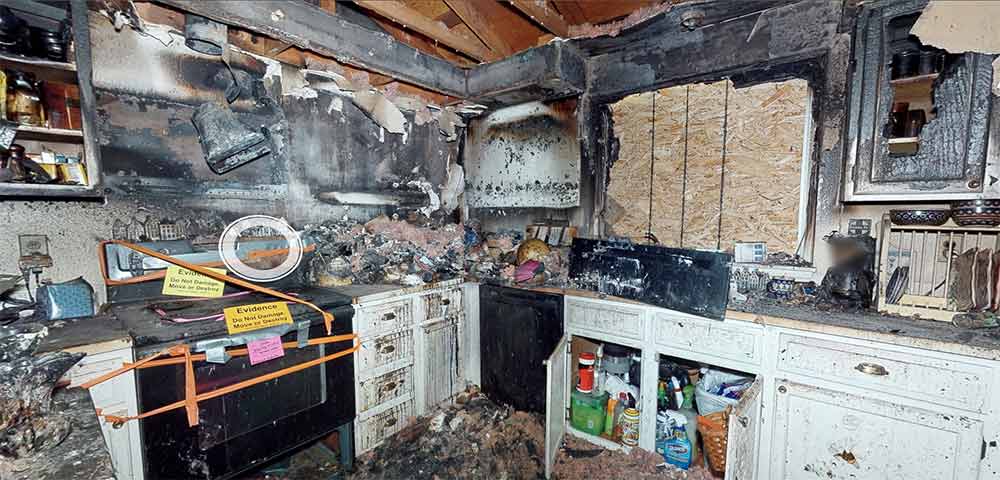
Matterport 3D scanning technology is making waves in the insurance and restoration sector, specifically in how insurers approach and handle claims.
With its detailed, immersive views of properties, Matterport has massively improved documentation accuracy, speeds up inspections, and enhances communication among all parties involved. Addressing common challenges in the claims process, such as discrepancies in damage assessments and lengthy settlement times being just a few of the benefits.
We’ll be looking at five key ways Matterport 3D scanning streamlines the insurance claims process. From reducing fraud to improving the customer experience, these benefits show why Matterport is a must-have in insurance and restoration processes.
Improved Documentation Accuracy
Matterport’s 3D scanning technology has revolutionised property documentation with its ability to capture detailed, high-resolution digital twins of spaces. Unlike traditional methods that rely on photographs and written notes, which can often be incomplete or ambiguous, 3D scans provide a precise visual record.
This approach eliminates the risk of overlooking crucial details – for example, while normal photos might miss subtle structural damages or fail to convey the full extent of an issue, a 3D scan captures every aspect of a property in exact detail. This becomes even more important during the claims process, as it provides indisputable evidence of the property’s condition at the time of inspection.
This also means that the accuracy offered by Matterport reduces the likelihood of disputes between insurers and policyholders, as the 3D scans offer a clear and shared reference point.
All of this not only enhances the efficiency of the claims process but also builds trust, as policyholders feel more confident that their claims are being assessed accurately and thoroughly.
Speeding Up the Inspection & Claims Process
Another huge benefit Matterport brings to the table is the speed in which it’s able to scan and inspect properties.
Traditional inspection methods can be time-consuming, often requiring multiple site visits and extensive manual documentation. In contrast, Matterport’s technology allows for a complete and detailed scan of a property in a fraction of the time. Once scanned, the 3D model is readily accessible remotely, allowing adjusters and underwriters to conduct their assessments without being physically present at the site.
The remote access feature is particularly beneficial as it enables multiple stakeholders to review the property simultaneously, which helps to streamline the decision-making process.
Adjusters, for example, could identify and evaluate damages in a single session, cutting back the time needed to file reports and make recommendations. This means faster claims processing which allows policyholders to receive settlements and begin repairs more quickly.
This faster process not only improves customer satisfaction by minimising delays but also enhances operational efficiency for insurers.
Improved Communication and Collaboration
Better communication and collaboration are always going to be welcomed in the insurance and restoration claims process.
By providing an immersive, interactive 3D model of a property, Matterport helps bring all parties together – namely insurers, claimants, adjusters, and contractors. All of them will have a unified view of the property in question, and this shared visual reference helps to remove any misunderstandings and discrepancies that often come with traditional methods.
For example, an adjuster can use the 3D model to highlight specific areas of damage and discuss them in detail with the claimant and contractors, all while viewing the same virtual space. This real-time interaction ensures that everyone is on the same page.
Plus, the ability to revisit the 3D model at any time allows for ongoing collaboration without the need for repeated site visits. This not only saves time but also ensures continuity and consistency throughout the claims process – so everyone’s happy!
Easier Claim Validations and Fraud Prevention
Arguably one of the hardest challenges insurers face is the detection and prevention of fraudulent claims. Matterport’s tech helps address this issue head-on by providing highly detailed and accurate digital records of properties.
This kind of precision makes it extremely difficult for fraudulent claims to slip through the cracks. Insurers can compare pre and post-incident scans to verify the extent and legitimacy of the damage.
For example, if a claimant reports extensive fire damage, the insurer can use the pre-incident 3D scan to confirm the property’s original condition. This comparison not only validates the claim but also ensures that the damages are accurately assessed, preventing exaggeration or misrepresentation.
The transparency provided by Matterport scans also helps discourage claimants from attempting fraud in the first place, because every detail of their property has been meticulously documented from the start.
Essentially, insurers that implement Matterport 3D scanning into their claims process gain the ability to swiftly validate legitimate claims while effectively dismissing fraudulent ones.
Better Customer Experience
Regardless of the industry you’re in, if there’s a way to offer a better experience to your customers, you’ll hang around to find out more. Matterport’s standout feature for improved customer experience comes down to the transparency and clarity it provides.
Policyholders can see detailed 3D models of their properties, making it easier for them to understand the extent of the damage and the necessary repairs. This visual clarity reduces confusion and helps manage expectations more effectively.
We’ve already talked about how Matterport can help speed up the claims processes, but this is also a huge benefit for claimants looking for a quick solution. Basically, faster inspections and assessments lead to quicker settlements, which is crucial for policyholders dealing with the stress of property damage. Knowing that their claim is being handled promptly and accurately gives customers peace of mind during what’s typically a pretty stressful time.
It’s also worth noting that policyholders will actually appreciate insurers who invest in modern solutions to improve service quality. This commitment can lead to higher customer satisfaction and loyalty, as clients feel valued and well-supported throughout the claims process.
Conclusion
It’s no surprise that Matterport’s 3D scanning technology is fast becoming one of the most essential tools for the insurance claims sector. By offering things like better documentation accuracy, greater time efficiency and improved collaboration, Matterport is addressing many of the industry’s biggest challenges.
As the insurance industry continues to evolve, implementing technology like Matterport’s will be essential for staying competitive and delivering the best possible service to their customers.
Provides detailed, high-resolution digital twins of properties, reducing discrepancies in damage assessments and providing indisputable evidence during claims.
Accelerates property inspections and claims processing through rapid, remote access to 3D models, minimizing delays in settlements and repairs.
Facilitates better collaboration among insurers, claimants, adjusters, and contractors with shared, interactive 3D models, reducing misunderstandings.
Helps detect and prevent fraudulent claims by comparing pre-incident and post-incident scans, ensuring accurate assessment of damages.
Offers transparency and clarity to policyholders through visual models, speeding up claim resolutions and improving satisfaction and loyalty.
What is an as-built survey and how does 3D laser scanning help?
An as-built survey documents the exact dimensions and layout of an existing building or structure. Using 3D laser scanning, millions of measurement points are captured to create an accurate digital representation of the space. This data can then be used to produce BIM models, CAD drawings, floor plans and point cloud datasets, helping architects and engineers design renovations or new works with confidence.
What is the difference between LiDAR scanning and photogrammetry?
LiDAR scanning uses laser sensors to measure distances and capture millions of highly accurate spatial points, creating a precise 3D point cloud of a building or environment. Photogrammetry uses overlapping photographs to reconstruct 3D models, which can be useful for visualisation but is generally less accurate for measurement. For architectural surveys, construction planning and Scan-to-BIM projects, LiDAR scanning is typically preferred because it delivers higher accuracy and more reliable spatial data.
How much does a 3D laser scanning project cost?
The cost of a 3D scanning project depends on several factors including site size, building complexity, deliverables required and the type of scanner used. Smaller projects may be completed for a few thousand dollars, while larger commercial or infrastructure projects require more extensive capture and modelling work. A tailored quote is typically provided after reviewing the project scope.
Can 3D scanning be used for renovations and refurbishment projects?
Yes. Laser scanning is widely used to create accurate existing-conditions documentation before renovation or refurbishment work begins. By capturing the building geometry in detail, designers and contractors can reduce measurement errors, improve coordination and avoid costly rework during construction.
Do you provide 3D laser scanning services across Australia?
Yes. 3D Walkabout operates scanning teams across major Australian cities including Sydney, Melbourne, Brisbane, Perth and Adelaide, and can deploy to regional and remote locations nationwide. Our team regularly works on projects ranging from single buildings to large industrial and infrastructure sites.
What is Scan-to-BIM modelling?
Scan-to-BIM is the process of converting laser scanning data into a Building Information Model (BIM). Using the captured point cloud, specialists create detailed digital models of the building in software such as Autodesk Revit. These models can include architectural, structural and MEP elements depending on the required Level of Development (LOD).
What is a point cloud and how is it used?
A point cloud is a digital dataset made up of millions of measured points that represent the exact geometry of a building or environment. These datasets allow architects, engineers and contractors to analyse existing conditions and create accurate models. Point clouds are commonly used as the foundation for Scan-to-BIM and as-built documentation.
What deliverables do you receive after a 3D scanning project?
Typical deliverables include registered 3D point cloud datasets, BIM models, CAD drawings, panoramic imagery and digital walkthroughs. Files can be provided in formats such as RCS/RCP, E57, Revit models and DWG drawings so they integrate easily into common design and construction software.
How long does a 3D laser scanning project take?
The time required depends on the size and complexity of the site. Smaller buildings can often be captured in a few hours, while larger commercial or industrial sites may take one or more days of scanning. Once the data is captured, processing and deliverables such as point clouds or BIM models are typically delivered within several business days.
What types of buildings and spaces can be scanned?
3D laser scanning can be used on almost any built environment including residential buildings, commercial offices, retail centres, industrial warehouses, hospitals, schools, infrastructure sites and heritage buildings. Large facilities such as campuses, factories and shopping centres can also be scanned using mobile LiDAR technology.
How accurate is LiDAR scanning for construction projects?
Modern terrestrial laser scanners can capture measurements with millimetre-level accuracy, depending on the equipment used. Survey-grade scanners such as the Leica RTC360 can achieve accuracy of around ±1.9 mm at 10 metres. This level of precision makes laser scanning suitable for architectural surveys, construction verification, and detailed BIM modelling.
What is 3D laser scanning for buildings?
3D laser scanning is a reality capture technology that uses LiDAR sensors to measure buildings and environments with millions of precise data points. The result is a highly detailed 3D point cloud that represents the exact geometry of the space. This data can then be used for Scan-to-BIM modelling, CAD drawings, digital twins, and building documentation.